


Urban rail transit trains feature frequent starts and stops. Massive regenerative electric energy is generated during braking upon arrival at stations, while substantial power is consumed for acceleration when departing.
Statistics show that braking energy accounts for approximately 40% of the total traction energy consumption. Without effective recycling, such energy is either dissipated as heat via braking resistors or fed back to the power grid through inversion, bringing about issues such as harmonic interference and high additional ventilation power consumption. Meanwhile, grid voltage fluctuations and excessive rail potential also hinder the safe and economical operation of rail transit power supply systems.
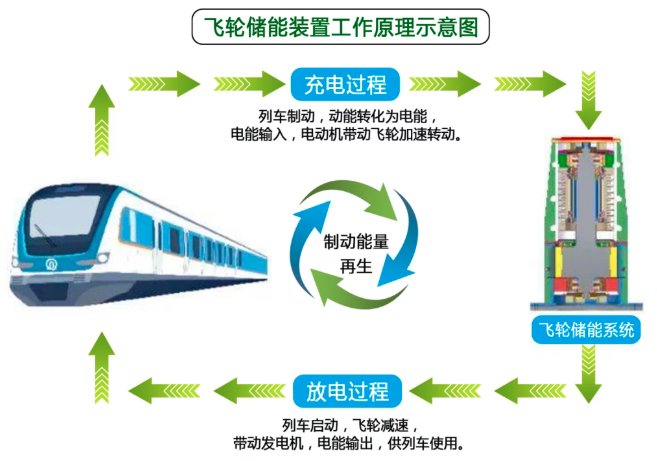
Tailored for rail transit scenarios, the Yuankong maglev flywheel energy storage system adopts a centralized layout and array-based expandable structure. Deployed at core nodes including traction substations and stations, it enables instant recovery and release of braking energy with strong adaptive regulation capacity for diverse operating conditions.
Leveraging maglev bearings and vacuum chambers, the system allows contact-free high-speed rotation of rotors to realize bidirectional conversion between electric energy and kinetic energy.
Energy Storage Mode
Regenerative power produced by train braking drives flywheel rotors to accelerate via the Power Conversion System (PCS), converting electric energy into high-speed kinetic energy for storage as the flywheel speed rises.
Energy Release Mode
When trains speed up for departure, decelerating flywheels release kinetic energy, which is converted back into electric energy through PCS and fed into the traction power grid for reuse by trains.
The whole process involves no chemical substances, featuring inherent safety and zero pollution. With a charge-discharge response time below 10 milliseconds, the system perfectly matches the instantaneous power demand of train operation.
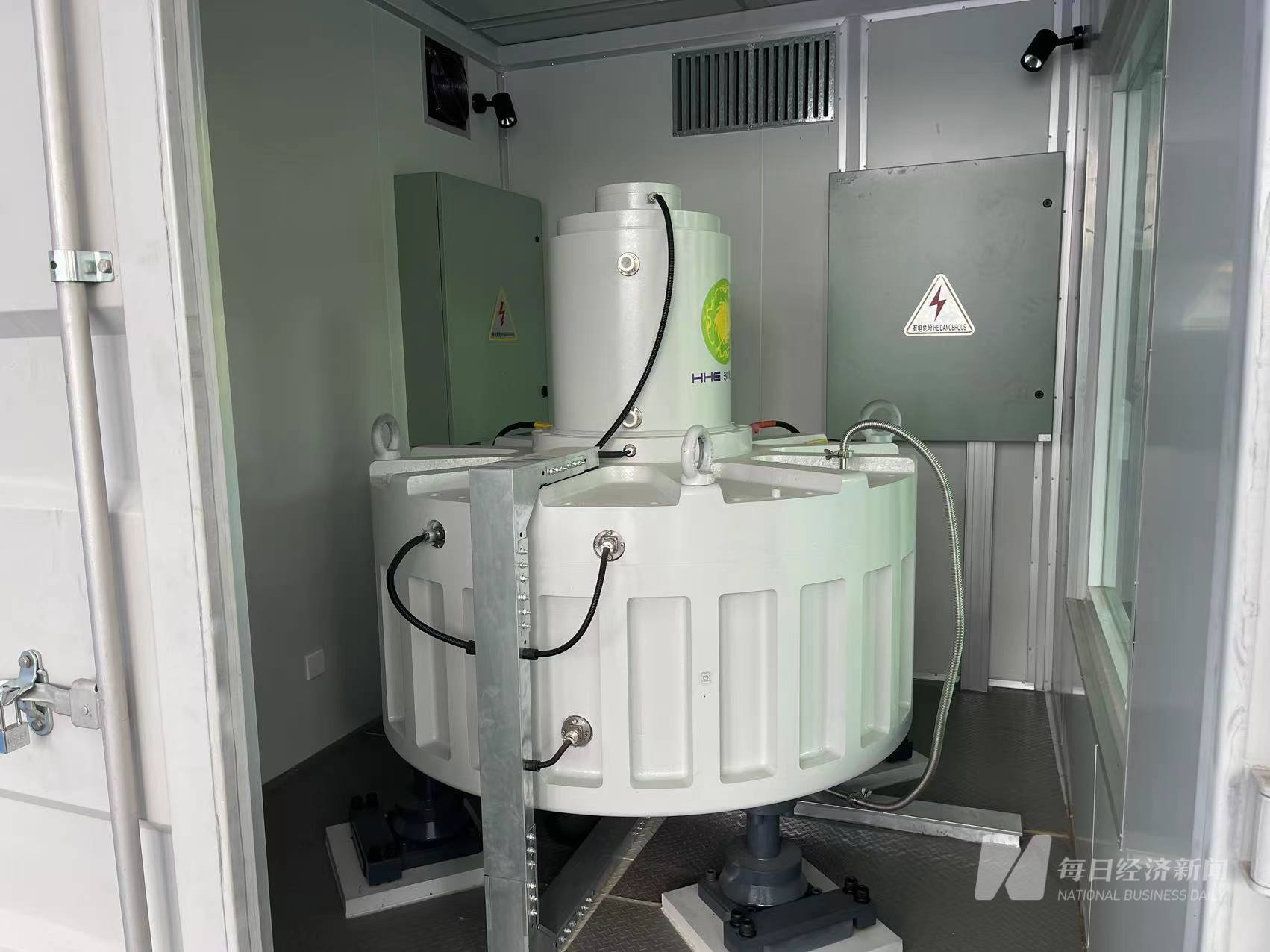
The system operates purely through physical motion: external electric energy drives bidirectional motors to spin flywheel rotors rapidly in a vacuum for energy storage; when power output is needed, decelerating rotors drive generators to convert stored kinetic energy into electricity.
Built with high-strength and low-density carbon fiber composite materials, the rotors run steadily at tens of thousands of revolutions per minute in vacuum environments. Maglev bearing technology minimizes friction loss, enabling the system to achieve an energy conversion efficiency of over 93% and millisecond-level charge-discharge response.
Capable of energy absorption and release within milliseconds with a switching delay of less than 10ms, the system efficiently recycles and reuses short-duration, high-power regenerative braking energy without waste.
Given dense train schedules, braking energy recovery equipment must withstand frequent charge and discharge cycles. The Yuankong system supports tens of millions of cycles with a design lifespan exceeding 20 years and zero rated capacity attenuation throughout operation, free from performance degradation caused by frequent cycling.
It requires no regular battery replacement or complex temperature control systems. The one-time long-term investment eliminates recurring battery replacement costs and locks in low operational expenses from commissioning onward, delivering superior full-lifecycle economic benefits compared with electrochemical energy storage solutions.
Free from thermal runaway risks, explosion hazards and hazardous chemical disposal needs, the system poses no extra fire safety risks even when installed in underground stations and densely-operated rail transit venues.
Adopting a modular design, the system allows flexible flywheel array configuration based on the capacity demand of traction substations to expand power and energy capacity as required.
Core Pain Points Solved
Traditional braking resistors waste regenerative energy by converting it into heat; the flywheel system recycles and reuses such energy to cut overall traction power consumption.
Direct grid feedback of regenerative power easily triggers voltage fluctuations and harmonic pollution; the system acts as an effective buffer to smooth power output and mitigate grid impact.
Conventional solutions entail regular maintenance for braking resistors and extra costs for harmonic governance; the flywheel system is nearly maintenance-free throughout its service life to reduce long-term operational costs.
In case of power supply failures, the system can discharge stored energy temporarily to provide emergency traction power or auxiliary power supply, greatly enhancing the reliability of rail transit power supply.
Application Benefits
Recovered braking energy can be promptly released to the traction grid to power adjacent accelerating trains, avoiding double energy conversion losses caused by grid power transmission and reuse. Boasting an overall charge-discharge efficiency above 90%, the system drastically cuts grid power intake for traction systems.
For an urban rail line operating 200 train pairs daily, the deployment of flywheel energy storage can reduce traction energy consumption by 15% to 25%, slashing annual electricity expenses by millions of RMB. The saved power costs within its 20-year service life can fully cover the initial equipment investment.
Uncontrolled regenerative power may push up grid voltage during braking and lead to voltage drops during train acceleration, disrupting normal train operation and raising equipment failure risks. Supported by millisecond-level response, the system absorbs surplus power amid voltage surges and releases energy during voltage dips, stabilizing traction grid voltage within standard ranges, cutting voltage fluctuation amplitude by over 50%, and improving train operational stability and punctuality rate.
Unrecycled braking energy dissipated via resistors can raise surface temperatures to hundreds of degrees Celsius, increasing ventilation and refrigeration loads of station environmental control systems. The large-scale application of flywheel energy storage sharply reduces the usage frequency of braking resistors, optimizing ambient temperatures in tunnels and platforms, and lowering station ventilation energy consumption by 10% to 15% while improving passenger and staff thermal comfort.
Frequent grid voltage swings and repeated activation of braking resistors accelerate insulation aging of rectifiers, switchgears, cables and other power facilities, alongside regular maintenance and replacement of resistors. The flywheel system stabilizes power fluctuations and eases impact on power equipment, cutting equipment failure rates by over 30%, extending maintenance intervals and reducing spare parts consumption.
In extreme scenarios such as traction substation power outages and grid failures, stored kinetic energy can be converted into electric energy to support low-speed train operation to the next station, or supply uninterrupted power for signal systems, ventilation, lighting and other critical loads. Featuring inherent safety without fire risks, it is suitable for safe deployment in enclosed underground spaces.
As the vital backbone of urban operation, urban rail transit calls for efficient braking energy recycling to elevate overall energy efficiency. Adopting pure physical energy storage technology, Yuankong maglev flywheel energy storage delivers millisecond response, ultra-long cycle life and zero full-lifecycle capacity decay, turning wasted braking energy into reusable clean power.
It is not merely a substitute for traditional solutions, but an essential upgrade optimizing the underlying logic of rail transit power supply systems — shifting from passive energy consumption to active energy recycling, and from reactive fluctuation response to proactive power stabilization. Yuankong is committed to empowering green, efficient and safe urban rail transit with reliable physical energy storage technologies.
